Pros & Cons Matrix for Tough Choices
Stop making overwhelming decisions by guesswork. Learn how a visual pros and cons matrix brings clarity to complex choices and reduces decision anxiety.
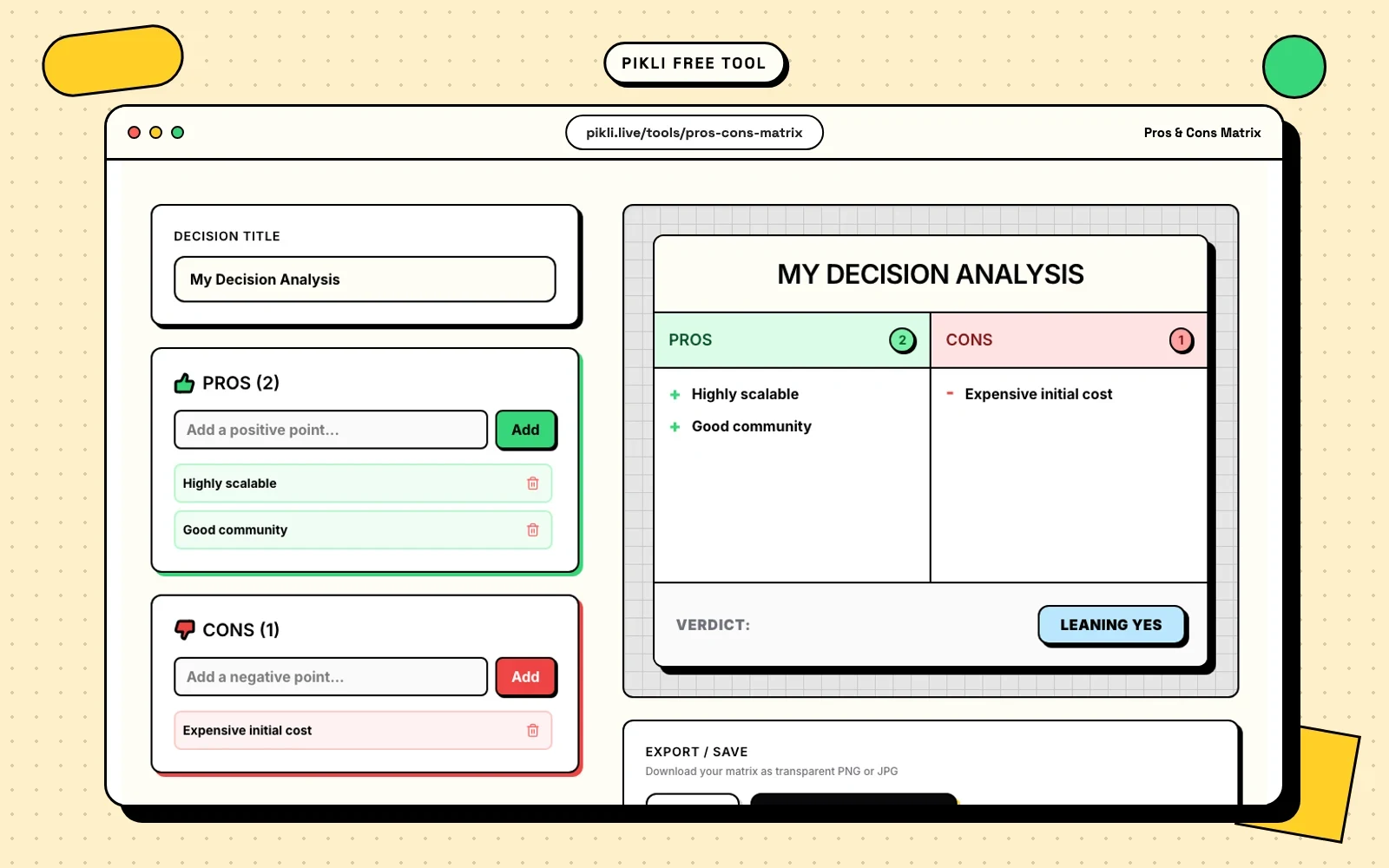
Most people already know the basic move: write down the pros, write down the cons, and compare the two lists.
That is a good start, but it breaks down as soon as the decision gets more complex. A shorter commute may matter less than growth potential. Lower price may matter less than long-term fit. Traditional lists flatten those differences.
That is why a matrix works better. Instead of collecting thoughts in a loose list, you compare options against the criteria that actually matter and give those criteria the right weight.
Why a plain list is not enough
Simple lists have three common problems:
- They treat every factor as equally important.
- They make it hard to compare more than two options.
- They do not show which tradeoff is doing the real work in your decision.
If you are choosing between jobs, vendors, tools, apartments, or strategic bets, those weaknesses show up quickly.
What a matrix adds
A good pros and cons matrix asks you to do two separate things:
- Define the criteria you care about.
- Score each option against those criteria.
That separation is useful because it forces clarity. Before you argue about which option wins, you first decide what “winning” means.
Typical criteria include:
- cost,
- time required,
- long-term upside,
- ease of adoption,
- risk,
- confidence in execution.
When you rate options against those criteria, the matrix gives you a visible explanation for the final result instead of a vague feeling.
A simple way to use it well
You do not need a heavy consulting process. A practical matrix can be quick:
- List the options you are seriously considering.
- Choose 4 to 7 criteria.
- Assign importance to each criterion.
- Score every option honestly.
- Review the total and then inspect the biggest drivers.
The last step matters. A matrix is not there to replace judgment. It is there to make your reasoning visible.
If the result surprises you, ask why. Sometimes the scoring exposed a real priority you had not stated clearly. Other times it shows that your criteria need to be adjusted.
Good use cases for a pros and cons matrix
A matrix is useful when:
- there are multiple acceptable options,
- the tradeoffs are real,
- multiple people need to agree,
- or you want a record of how you made the call.
It works especially well for hiring decisions, software selection, project prioritization, pricing choices, and personal planning.
Try Pikli’s free Pros & Cons Matrix
If your team is circling the same debate over and over, a visible matrix usually helps. It turns vague opinions into specific comparisons.
You can use the Pros & Cons Matrix to compare options, assign weight, and get a clearer read on where your choice is really pointing. It is free to use and built for fast decisions when you need structure more than another opinion.
Start simple, keep the criteria honest, and use the output to have a better conversation with yourself or your team.
Free to use on Pikli
Try Pikli's free Pros & Cons Matrix
Compare options, weight the tradeoffs, and stop circling the same decision.
Want to turn the decision into live team input? Start free with Pikli .
Continue exploring
Related guides
Go deeper with practical articles selected from the same topic cluster.
Free Quadrant Maker for Fast Analysis Charts
Learn how quadrant charts turn complex tradeoffs into clear visuals, and when frameworks like Eisenhower or BCG help teams compare priorities fast.
Read article → 02Random Choice Picker for Fair Decisions
Overcome decision paralysis with a fair, fun random choice picker tool. Learn why your brain fights simple choices and how randomness can help.
Read article → 03Free Tier Maker for Shareable Visual Rankings
Tier lists turn opinions into visuals people can scan, challenge, and share. Learn when a tier maker works best and how to pair it with Pikli for live input.
Read article → 04Top X Generator for Fast Visual Rankings
Create professional visual rankings instantly with our free Top X generator. Perfect for social media, presentations, and content marketing.
Read article →